Toyota: 0 to 60 (% hybrids) in 31 years
It took from 1997 to 2009 – from Titanic to Avatar – for Toyota to break even, overall, on gasoline hybrids.

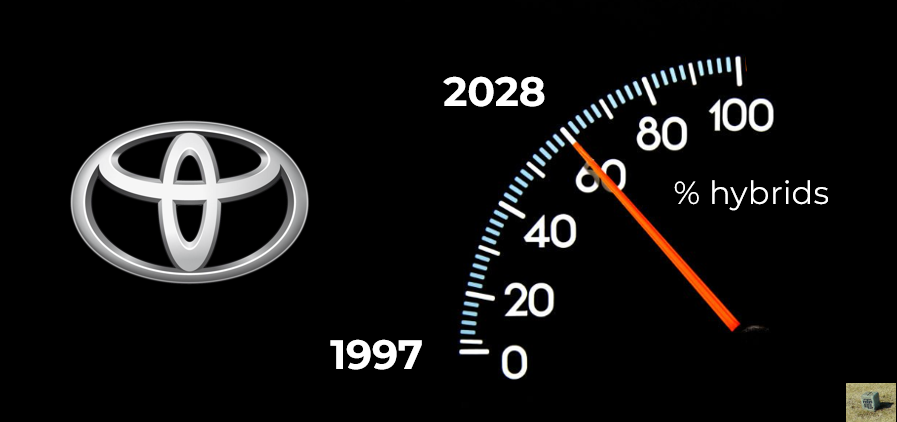
Toyota announced on Feb 4 that they would boost worldwide hybrid (and plug-in hybrid) production to 6.7 million by 2028. Based on 11.3 million sales per year, hybrids (of various sorts) would top 60 percent of their worldwide sales.[1]
The first-generation Prius debuted in December 1997, concurrent with the COP3 Kyoto climate conference of “Kyoto Protocol” fame. So, if you’ll pardon the pun, Toyota will have gone from 0 – 60 in 31 years.
Change in the automotive sector takes time.
That’s something to keep in mind as passenger cars electrify. It’s an adoption curve, not an adoption step function.
1997-2003: Hybrid Investment
The Toyota Prius hybrid debuted in 1997 and was sold in very limited numbers and only in Japan through 1999. These are thought to have been sold at half the cost of production (!) so their being sold in limited numbers is unsurprising. Customers paid about USD $17,000 per early first-generation Prius. They cost Toyota $32,000 to manufacture.[2]
Inflation-adjusted, and in Canadian dollars, that would be like a sticker price of roughly CAD $45,000 for a vehicle costing $85,000 to build. Economics rivalling some automakers’ very earliest electric vehicles. 😉
This isn’t a slam against electric vehicles – it’s the nature of the auto industry.
After a few years the Prius launched internationally. The aluminum-body Honda Insight beat it to North America by a few months. Toyota soon dwarfed Honda in hybrid sales and mindshare, and most people now associate aluminum-body cars with Tesla.
Between incremental improvements and higher volumes (mass production effects) Toyota is thought to have broken even on build cost in these later years of first generation hybrids: the build cost was in line with the sales price [to dealerships].
A zero emission vehicle (ZEV) analogy would be how the first generation Nissan Leaf is commonly thought to have been sold at a loss at first – costing in the high USD $30,000’s to build and retailing in the low $30,000’s. Falling battery prices and incremental improvements helped Nissan sell the first generation Leaf above cost-of-production, in subsequent years.
2003 - 2009: Hybrid Return-of-Investment
Industry thinking is that that Toyota turned enough of a profit on its second generation hybrid technology … to recoup its original development costs.
That is, it took from 1997 to 2009 – from Titanic to Avatar – for Toyota to break even, overall, on gasoline hybrids.
Think of Toyota’s second generation hybrids as a return-of-investment. They made a bet on a strategic technology and after 12 years had finally broken even – as delighted as someone making that last payment on their student loan. Now, just as they were mapping out how to spread hybrids across their product portfolio and earn some profits … climate advocates wanted them to focus on battery electric vehicles.
They didn’t.
Enjoying Toyota's hybrid adventures? Sign up for more Eclectic Lip!
2009 – today: Hybrid Return-on-Investment
Toyota steadily expanded gasoline hybrids (HEVs) across its lineup with the third-generation system (roughly 2009 to 2015), fourth-generation system (roughly 2015 to 2022) and now its fifth-generation system (2023 to present). And returning to the start of this post, by 2028 it expects 60 percent of the vehicles it sells worldwide to be hybrids of some sort.
The company says that since it charges a small premium for hybrids – call it $2000 – the profit margins on their HEVs are the same or higher, than for gasoline-only vehicles.[3] Those profits are now paying for their belated battery electric vehicle (BEV) efforts.
There’s a Circle of Life element: decades ago, Toyota’s gasoline vehicle profits funded its hybrid technology; today, Toyota’s hybrid profits are funding its BEV rollout.
There’s a library of essays arguing Toyota’s hostility to battery electric cars was a sunk-cost fallacy (doubling down on a bad bet) or the Innovator’s Dilemma (where a disruptive new technology upends incumbents). I wrote one of them in 2013, pulling in Kleiber’s Law from biology.
But for consumer goods with brand loyalty dynamics in a gruesomely capital intensive industry with extremely long product cycles, you can survive as a “follower”. Betting on sudden disruption is how to not survive. This definitely does not apply at all in some other industries, but it does apply when it comes to autos.
An old industry saying – cribbed from aviation – is that there are bold car companies and old car companies, but no old, bold car companies.
And it was bold to assume car buyers would change behaviours – in 2010 Nissan’s CEO thought they would sell 500,000 first-generation Nissan Leafs per year (knock off a zero and he was close).[4] Bold just isn’t in Toyota’s DNA. They also dragged their feet on self-driving cars. Depending how you slice it, they ranked 14th, 15th or 17th in autonomous miles driven in California in 2022.[5]
Crawl – Walk – Run
Toyota’s slow, plodding strategy has fared well compared to the tactics of some competitors who mostly slept through hybrids then tried to sprint into BEVs.
But before looking at the entrails of the latter’s losses, Hyundai/Kia – no hybrid slouch itself – deserves credit for arguably navigating the transition better than Toyota. For years the unofficial word has been that they’re the only [non Chinese] car company Toyota worries about.
In 2025, 42 percent of Toyota’s worldwide sales were gasoline hybrids compared to 15 percent for Hyundai/Kia – but another 9 percent of Hyundai/Kia’s sales were ZEVs versus Toyota’s 3.5 percent. And while Toyota’s all-out opposition to [hybrid-unfriendly] ZEV mandates in favour of [hybrid-friendly] fuel efficiency standards enraged environmentalists, their Korean arch-rival kept their heads down. It’s hard to quantify the cost of deeply offending many passionate people, but it’s probably large. Hyundai/Kia spread its bets, avoided drama, and has a big lead on the battery electric side.
As for competitors such as Volkswagen (USD $6 billion in recent EV-related write-downs), General Motors ($7.6 billion), Ford ($19.5 billion) and Stellantis ($26 billion) the first line of Anna Karenina comes to mind. “Happy families are all alike; each unhappy family is unhappy in its own way.”
One common likeness remains: their leadership teams underestimated hybrids.
To borrow from the crawl / walk / run expression, they would have been better off patiently progressing from gasoline-only (crawl) and then to hybrids (walk) before going all-in on zero emission vehicles (run). They tried to skip “walk”. Most car buyers probably go through all three stages too. In fairness ZEV regulations would have made the “crawl / skip walk / run” strategy look appealing. Overenthusiastic advocates, too; me among them.
Even Chinese powerhouses exporting to Europe have expanded from BEVs to include plug-in hybrid and even gasoline hybrid options. This is partly in response to specific tariffs on BEVs made in China, but it also broadens their potential customer base: 17 percent of vehicles sold in Europe last year were battery electric, but fully 60 percent of European car buyers bought one of (BEV, plug-in hybrid, gasoline hybrid).[6]
Toyota as Tortoise
Aesop’s fable of the Tortoise and the Hare is one way to frame Toyota’s success. It didn’t come through sudden breakthroughs or bursts (which would be Hare-like) but through continuous improvement and incremental change. That includes very deliberately evolving from gasoline-only to gasoline hybrids and then plug-in hybrids and finally battery electric vehicles – and even some hydrogen fuel cell vehicles too: the platypus of evolutionary tree; the Basque of Spanish languages; the lacrosse of Canadian national sports.
Furthermore, tortoises are known to move slowly, be stubborn, survive harsh conditions – and sometimes, to be very long lived.
We can still cheer combustion-era automakers on their journey and track their progress from 0 to 60 (% zero emission vehicles) – and then on to 100. With a lot of work and a little luck, they’ll need less time than Toyota’s 31 years to go from 0 to 60 percent, with respect to hybrids.
Have a friend who might enjoy this? Please send it their way! 😊
[1] Down in the weeds, there is conflicting math. Toyota Motor Corporation produced 11.3 million vehicles in 2025, though 0.8 million come from Daihatsu and Hino; the press release said Toyota’s production would increase 10 percent to 11.3 million by 2028. Raising Toyota-Lexus production by 1 million vehicles per year in two years is risky, unlikely, and doesn’t match the [lack of] new factory announcements.
My guess is as follows. Hybrids were 40% of Toyota’s global sales in 2025, and Toyota’s earlier plan was for 50% to be hybrids in 2028. They now aim for 60% to be hybrids in 2028, which is a 10% increase (over the prior 50% target).
[2] Car dealerships buy at a discount to manufacturer’s suggested retail price get, so Toyota would have sold these to dealerships below USD $17,000.
[3] https://ca.investing.com/news/stock-market-news/toyota-and-honda-reap-financial-gains-from-surging-hybrid-sales-3411867
[4] https://archive.nytimes.com/wheels.blogs.nytimes.com/2010/11/16/nissan-will-sell-500000-electric-cars-a-year-by-2013-says-chief/
[5] https://thelastdriverlicenseholder.com/2023/02/17/2022-disengagement-report-from-california/
[6] https://www.acea.auto/pc-registrations/new-car-registrations-1-8-in-2025-battery-electric-17-4-market-share/