The Wartime Mobilization for Climate Happened. In China.
If not for China’s wartime mobilization, the world would have deployed one-half as many solar panels, one-third as many electric vehicles, and one-quarter as many wind turbines last year.

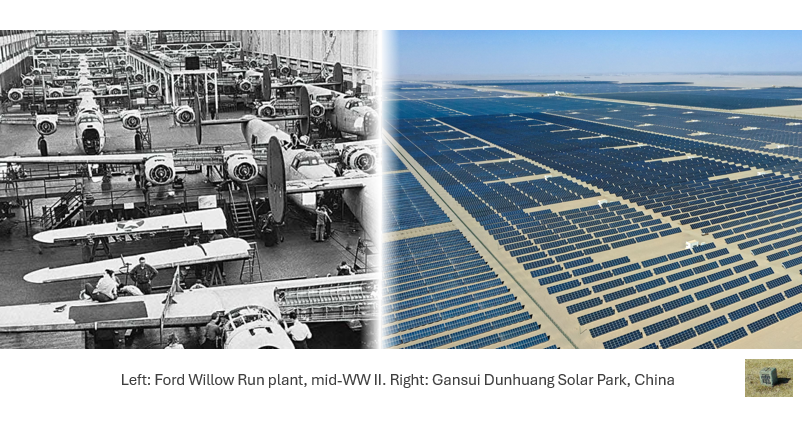
Arsenal of democracy, meet the arsenal for climate
For as long as I can remember, I’ve heard that to address climate change, we need a wartime mobilization of industry on par with the United States’ scale-up of military production in World War II. The phrase comes from a 2001 paper by Dennis Bartels in the journal Human Ecology.
It’s 2026 and the wartime mobilization did happen.
In China.
Arsenal for Climate
Even before it entered World War II, Franklin Delano Roosevelt referred to America’s unprecedented industrial capacity as the arsenal of democracy which could be squarely aimed at the Axis powers. And during the war the United States was responsible for about two-thirds of Allied military production.
China’s solar panel, wind farm, battery and electric vehicle (EV) production – its “arsenal for climate” – is more dominant still. According to the Clean Energy Monitor, China encompasses 66 percent of world EV production capacity, 73 percent for wind turbine nacelles (the central part around which the turbines blades spin), 83 percent for batteries, and 92 percent for solar photovoltaics.
Phrased differently, during World War II the United States produced 2x as much as the rest of the Allies. Today China’s current EV production capacity is 2x as much as the rest of the world. For wind it’s 3x, for batteries 5x, and for solar photovoltaics 11x.
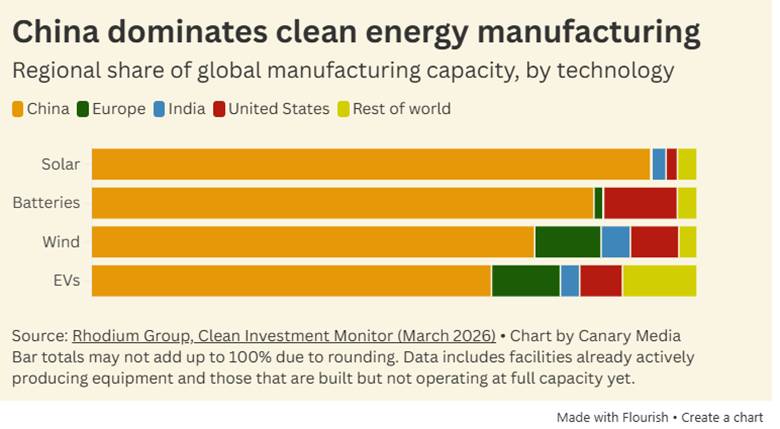
To use a British Columbia metaphor, China’s solar production capacity towers over other countries’ like a Douglas fir in a bonsai forest.
This is neither to suggest that the end of hydrocarbons (fossil fuels) is nigh – it isn’t – nor that we should put our feet up and let China take care of everything – we shouldn’t. It is to say that idealists, the author included, got their wish. Not only has there been a wartime-scale mobilization that will (to use Bartels’ words) counter severe global climate change, but it happened in the world’s biggest industrial power.
So, while the glass of climate developments is half-empty – sobering disasters such as the 2021 heat domes that settled over British Columbia have happened decades earlier than expected – it’s also half-full: the scale of production of key technologies has arrived decades earlier than expected too.
We might ask why this wartime mobilization happened specifically in China.
War-like Concerns Beget War-like Production
China has broadly followed the East Asian Economic Model pioneered by Japan and copied with great success by South Korea, Taiwan and Singapore. The first two entered 1975 with lower per-capita GDPs than the neoliberal laboratory of Chile; they exited 2025 with per-capita GDPs about twice as high as Chile’s.
If you enjoy this, share with a friend! And if you received this, sign up to receive more!
A 1978 visit to the Singapore influenced Deng Xiaoping’s decision to change China into a market economy with strong central governance, such that private corporations couldn’t bully government the way foreign powers had bullied China during its so-called century of humiliation from roughly 1840 to 1950. But China is very different from its East Asian Economic Model predecessors.
China is so populous, its industries can harness human labour and intellect on a scale Japan, South Korea, and even the United States can’t match. This applies across the board, not just to clean energy technologies. China manufactures about two-thirds of the world’s household appliances – refrigerators, washing machines and the like.
More importantly, China isn’t part of the United States’ geopolitical security umbrella. For Japan and the Four Asian Tigers – South Korea, Taiwan, Singapore and Hong Kong – America has been a security guarantor; for China it’s a security threat.
China’s Pacific coast is encircled with US allies and bases, part of what is sometimes called the Island Chain Strategy. The diagram below from Australia’s Solidarity shows this. Unlike its predecessors, China has had to worry about the risk that the United States navy one day interdicts its seaborne fossil fuel imports. Which remain substantial.
Energy imports – some by land, some by sea – cover about 40 percent of China’s natural gas use and 70 percent of its oil, though part of the latter imports have gone into its strategic stockpile.
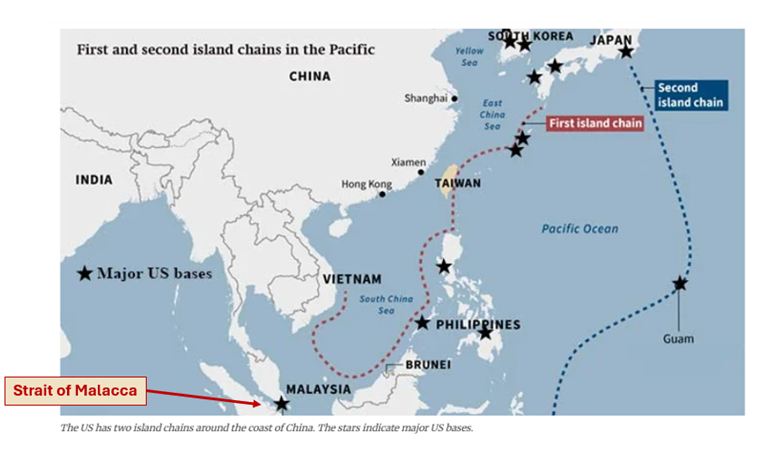
Blocking seaborne imports wouldn’t necessarily put US ships in drone range either. The United Kingdom has a base in Singapore overlooking the Strait of Malacca, which I've annotated on the graphic. Its importance dwarfs the Strait of Hormuz. While 20 percent of the world’s oil transits the Strait of Hormuz, 40 percent of the world’s trade transits the Strait of Malacca.
Its East Asian Economic Model predecessors could rely on the United States navy to guarantee safe passage for their energy imports, but China faces the war-like risk that the United States could cut those energy imports off. That war-like risk eventually induced a war-like response – the frenetic scale-up of production and deployment of solar photovoltaics, wind turbines, batteries, EVs and other technologies far beyond what “market forces” would have dictated.[i]
Broadly available figures have China deploying about 55 percent of all solar panels, 70 percent of all EVs and 75 percent of all wind turbines in the world in 2025. In very rough terms, if not for China’s wartime mobilization, the world would have deployed one-half as many solar panels, one-third as many electric vehicles, and one-quarter as many wind turbines last year.
China’s electrification push may have started off as a wartime mobilization to reduce dependence on seaborne fossil fuel imports because of encirclement by a geopolitical rival, but that industrial policy has functionally behaved like a wartime mobilization for climate – and in the world’s leading industrial power, no less.
Which is what Dennis Bartels, I, and probably a hundred thousand environmental advocates over the decades have hoped for.
There’s more to be done – the west shouldn’t rest on China’s laurels – but it is worth savouring those rare times when our wishes come true.
[i] In 2024 China’s solar industry had the manufacturing capacity to produce twice as many panels as were installed that year. This represents a catastrophic misallocation of capital – but even a stopped clock is right twice a day. This overcapacity means that solar deployment can ramp up dramatically in the rest of the post-Iran War / 2026-27 El Nino world, without there being a production bottleneck.
https://www.csis.org/analysis/chinas-solar-industry-upheaval-effects-will-be-global