Jane Goodall-ing with Elon Musk’s early, conservative critics, Part II: Eco-types
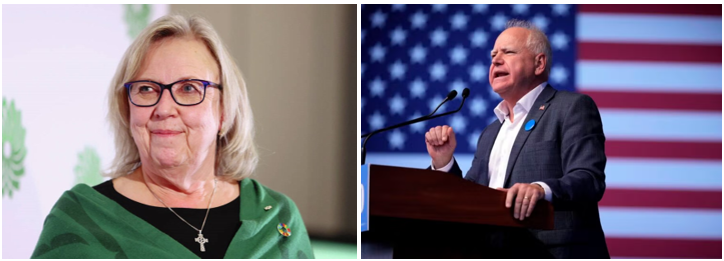
Interviewees' archetype of an environmentalist was “high status, liberal, female, and white”. Elizabeth May (Canadian Green Party leader) fits this perfectly.

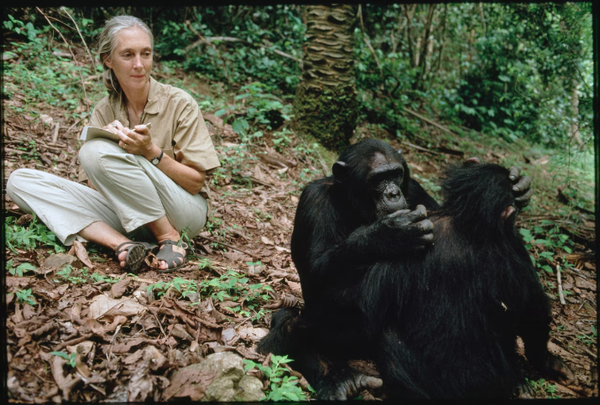
Part I described my “Jane Goodall” experience of finding myself accepted in a right-leaning community of Elon Musk’s early critics and engaging in mutually respectful dialogue with these people whose politics opposed mine.
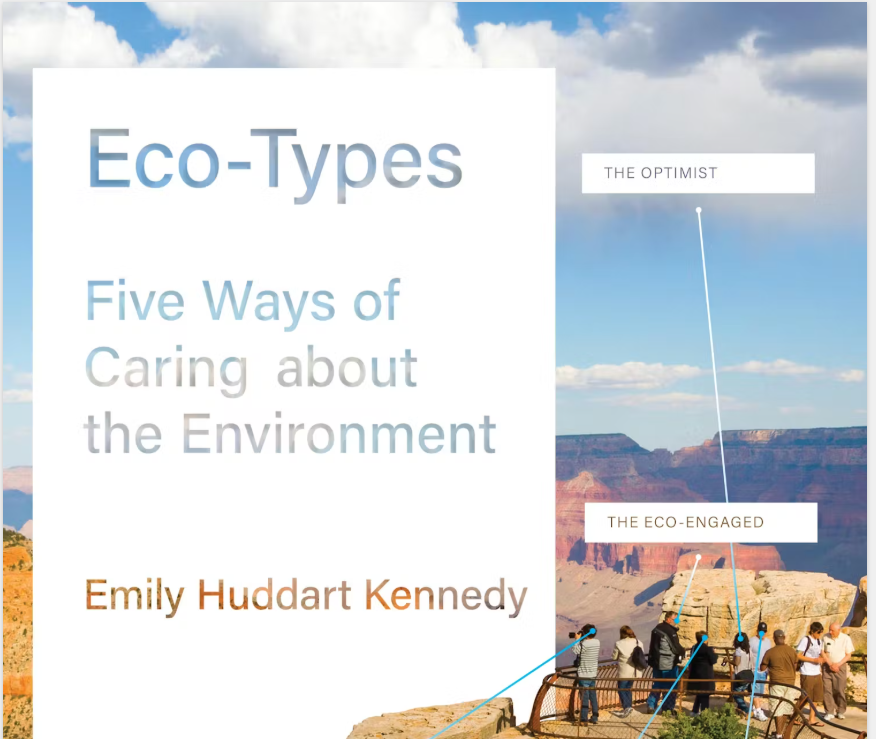
I was sure this had made me a better communicator but only had my anecdotes to rely on. Until I read UBC sociology professor Dr. Emily Huddart Kennedy’s recent book Eco-types: Five Ways of Caring about the Environment.
Paraphrasing online sources, eco-types are groupings or cohorts within a species (e.g. orcas) with different physical and/or behavioural traits (e.g. eating sea mammals and sometimes moose vs. eating fish) due to situational factors (e.g. locally available prey).
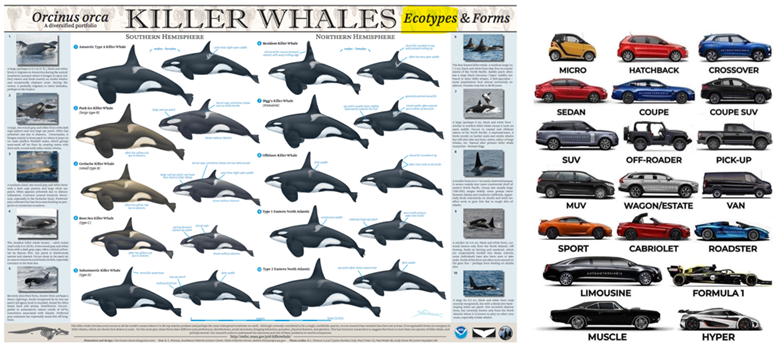
If we distinguished motor vehicles in similar terms, automobile eco-types might include the sedan (the archetypal four-door car), the hatchback (shorter trunk, well-adapted to cramped urban environments), the SUV (vertically taller, well-adapted to lugging hockey equipment), the pickup truck (well-adapted to off-roading, and to helping owners’ friends move each month) and many more.
Despite there being several eco-types, all orcas are recognizably orcas, and despite there being several automobile types (eco-types), all autos are recognizably autos.
Huddart’s insight is that while all humans are recognizably humans, we can be distinguished into different eco-types based on how we relate to the environment: we exhibit different behavioural traits due to situational factors such as our first-hand experiences and worldview. Political and religious affiliations may work the same way. Classifying people by eco-type may be scientific but still feels strange, so I’ll mostly use “cohort”, which has been applied to groups of humans since the Roman Republic.
Five Cohorts
Through in-depth interviews and commissioned professional polling, Dr. Huddart identified five broad cohorts (eco-types) of Americans based on how they relate to the environment. One imagines Canadian findings would be similar. An embryonic description of each cohort follows, but a full appreciation only comes from reading the book.
· The Eco-Engaged: a cohort that will overlap with many who work in cleantech, the Eco-Engaged most closely resemble collective society’s image of environmentalists. They’re about 1/3 of the US population.
On the good side, the Eco-Engaged do their moral best to minimize the environmental footprint in their consumer choices. On the bad side, they may try to “correct” others’ behaviours, unprompted. This drives resentment among other cohorts, who broadly feel judged. That’s really counterproductive to durable coalition building.
· The Self-Effacing share a similar worldview with the Eco-Engaged but feel like they fall short of the ideal – sometimes due to economic means. They perceive the climate crisis as severe, but not as acutely severe as the Eco-Engaged. Their social circles tend to be more heterogeneous, and they also believe more of the population is committed to environmental protection, than their Eco-Engaged friends.
These first two cohorts tend to be more politically progressive.
· The Optimists: anyone who has read Bjorn Lomborg’s work or heard its talking points knows the Optimist view that climate change is a small speedbump on the path to human self-actualization. “Just a flesh wound”, as the saying goes.
Optimists point to humanity’s progress over time as reason for confidence in the future. They see the ladder of capitalism raising the human condition. I see the scaffolding of popular social movements.
Dr. Huddart found that Optimists were more likely to relate to the environment in terms of visible factors (water pollution; litter) than invisible factors (CO2 concentration statistics).
Consider the Conservative government of Ontario’s 2018 Environment Plan. The term “greenhouse gas” had 46 mentions, as one might expect. But there were 19 mentions of “litter” (visible factor) while “carbon dioxide” and “CO2” (invisible factors) got four and three, respectively.
· The Fatalists: people in this cohort don’t think we have the agency or ability to fix environmental problems, individually or collectively. They tend to see humanity itself as the problem.
Fatalists’ lower trust in both government and business may contribute to this pessimism; it also brings right-wing libertarianism to mind. An Optimist/Fatalist dialogue might involve radically different conservative perspectives.
One also wonders if burnt-out Eco-Engaged people could turn into Fatalists – or whether Fatalists who join action-oriented communities making tangible progress, might turn into the Eco-Engaged.
· The Indifferent: people in this cohort may have causes they champion, but the climate isn’t one of them. This is understandable. Even in the best economic times, which we definitely aren’t in at present, many people face more immediate crises – affordability; housing; childcare or eldercare needs.
And many of those lucky enough to be economically secure will have commitments already saturating their attention. There’s more to a healthy, diverse society than just environmental volunteerism.
Elizabeth May, Environmentalist Archetype
Dr. Huddart’s interviewees’ archetype of an environmentalist was “high status, liberal [i.e. not politically conservative], female, and white”.
Elizabeth May (Canadian Green Party leader) fits this archetype perfectly. B.C. Green Party leader Emily Lowan fits it well, too.
One of our challenges as climate action advocates is that this archetype is non-inclusive of political conservatives. It would help to have a complementary, approachable-to-conservatives ideal. The first burly, conservative, conservationist hunter that comes to my mind is Teddy Roosevelt – who even took aim at business monopolies as President of the United States. Tim Walz, the turkey-hunting, football-coaching, Army National Guard member turned Minnesota governor, could probably pull this off. I don’t know who in Canada could.
Think-tanks and non-profits are full of effete, white-collar, university-educated urbanites like me – and I bet a portly, coarse spokesperson with “diner charisma” could better build a broader coalition for climate action. It’s not enough to win conversations in high-end coffeehouses; we need to win over the Tim Horton’s crowd – or at least be competitive.
Lessons for Self
Among the five cohorts, I see myself in the Self-Effacing eco-type. My ideals are with the Eco-Engaged, but emissions broadly track household income both globally and within Canada, and I’m lucky enough to be a white-collar worker in the Global North. Which means I’m part of the problem.
We’ve reduced our greenhouse gas emissions with ZEVs, and that has saved us money – but there will have been a rebound effect. Those savings got spent in a world powered 77 percent by fossil fuels, cannibalizing some of those GHG reductions. That’s the banality of emissions.
The Optimist cohort was well represented among my Musk-critical, conservative friends in TSLAQ, and Dr. Huddart’s systematic observations corroborated my mere anecdotes. They felt environmentalists looked down on them, which frustrated them, and made for good catharsis when I criticized such scorn as counterproductive. No one likes to be looked down upon. But putting other people down – creating a scapegoat outgroup – strengthens in-group unity, so we’re probably stuck with that behaviour as a species.
Abiding by the Golden Rule helped my TSLAQ friends be more open about their environment and energy assumptions, where I could offer perspectives and data from a different filter bubble. And their exchange helped me navigate past combative stereotypes of my own – like an ancient sailor exploring the “here be dragons” portion of a world map and discovering that the people over there weren’t that different after all.
But I’d still trade that growth, for us to have stopped him instead.