Fuel Cells: A Love Story 😊
The security guard asked why I was loitering by the front door in the pre-twilight darkness. Thus began my internship at Ballard Power Systems.


Introduction
One score and nine years [and pounds] ago, early on a lightly-raining January morning, I packed my lunch, donned my jacket, slung my backpack, locked the door, inserted my [wired] earphones, turned on my Sony Discman[1] and clomped in my boots to the offices of my new employer listening to a nine minute remix of New Order’s True Faith on auto-repeat.
I arrived at about 7:15, prompting the bewildered security guard to open the door and ask who I was, and why I was loitering by the front door in the pre-twilight darkness.
Thus began my co-op term [internship] at Ballard Power Systems.
This set of essays is about what happened next: one person’s technology development odyssey. It’s specific to me and to proton exchange membrane (PEM) fuel cells, but the insights will apply widely.
My tenure at Ballard ended in 2012, so it’s long enough ago that anything I share will be safely obsolete. I’ll also avoid or change specifics to steer clear of intellectual property subtleties and reputational sensitivities. It’s neither my intent nor interest to make people look bad.[2]
My three goals for this project are:
Goal 1 – A Time Capsule
I want to capture the lived human experience of a certain era of proton exchange membrane (PEM) fuel cell development. Most lived human experience is generalizable to other fields – think of Wayne Gretzky adapting lacrosse tactics into ice hockey – so the insights will still be relevant outside fuel cells.
Furthermore, lived human experience is special. Patents, statistics and published specifications are easy for large language models/AI to scrape and summarize – but to riff off Cory Doctorow, lived experience is part of the 99 percent of human knowledge that rarely gets written down and digitized. Technology changes but human foibles don’t, so there is value in entertainingly chronicling technology development at a particular company in a particular field in a particular decade. [If it isn’t entertaining, people will have chatbots summarize it in sterile sentences instead.]
Finally, my fuel cell career arc – and my professional career generally – has meandered in more directions than most. My work at Ballard ranged from suppliers and specifications to process and product development with disciplines ranging from 5S, 8D, designs of experiments and statistical process control, touched quality, failure analysis and manufacturing engineering, and spanned customers big (auto companies) and small. My tenure also included years mid- and post- stock market bubble, the early rise of electric vehicles, a theatre play and the briefest of cameos by the Dalai Lama and Al Gore. The latter won’t happen until 2006/07.
What I’m chasing is the late Ken Dryden’s book The Game, an autobiography of his last season in the NHL. It peels past [AI-summarizable] statistics to reveal the rhythms, routines and ruminations of hockey player life in the late 1970s. Of course, Ken Dryden was a consistent all-star goalie, whereas my annual performance reviews exhibited random Brownian motion.
Goal 2 – History by the Moved and the Shaken
There will also be value in a cleantech version of Howard Zinn’s A People’s History of the United States – Tony Soprano’s least favourite book – which considers events not as remembered by the movers and shakers, but as experienced by the moved and the shaken.[3] As Zinn showed – at least in the chapters I’ve actually read 😅 – these can be very different narratives.
Post dot-com bubble Ballard is a good example. Grand narratives, over-interpreting from the stock price, might think the company petered out. Setting aside the substantial “organizational weight loss”, my experience among the moved and the shaken was one of faster, more effective technology development.
A good analogy is how many people still think that between the collapse of [Western] Rome and the Renaissance, western Europe suffered a thousand years of stagnation: that was my impression from high school. In fact, the medieval period was shockingly innovative.[4]
Zinn’s book gives a necessary second perspective on American history, and I hope to use my specific knowledge from the fuel cell world, to provide an alternate view on technology development in general.
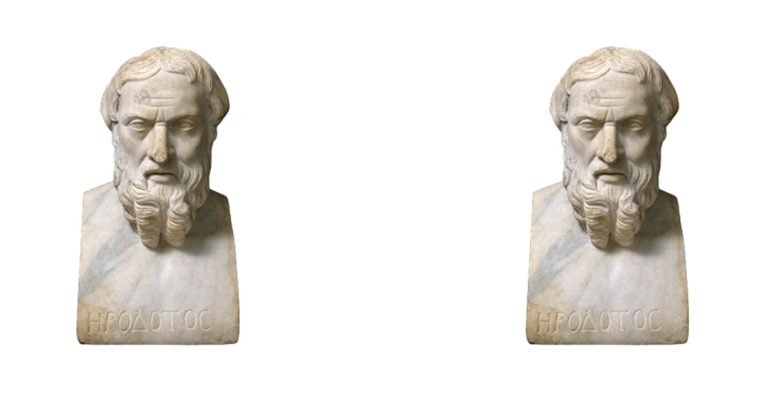
Goal 3: Hydrogen Herodotus
I’m going to strive for accuracy, and that includes providing useful context.
Where possible I’ll draw from personal experience or first-hand accounts to ensure accuracy. In this I will be emulating Herodotus, the Father of History – according to the Roman orator Cicero.
At other times I’ll be passing on second- or third-hand information, in which case I will be emulating Herodotus, Father of Lies – according to the Roman historian Plutarch.
Finally, when recounting my humorous mis/adventures I will be channeling Suetonius, Father of Gossip Magazines, whose tell-all book The Lives of the Twelve Caesars established the genre. Let’s all pour one out for Caligula’s reputation...
Don't miss an instalment of Fuel Cells: A Love Story. 😊
That brings us back to the morning of January, um, 6th of 1997.
As the minutes ticked by, the building began bustling and the rest of the co-op [intern] crop filtered in. My equally keen chemical engineering classmate was second to arrive. I got better marks than him, but he was and remains a better engineer than me. The missing context is that timed exams penalized his meticulous-but-laborious approach. I combined steps and maximized my mental math, giving me time to find mistakes on a second or third pass, to the benefit of my exam scores.[5] But real-life engineering relies more on carefulness than mere quickness.
My supervisor, perhaps still digging himself out of the North Vancouver Alps, arrived closer to 9 a.m. That’s where we’ll pick up from next time.
Have fuel cell colleagues or alumni in your life? Send this their way! 📨
[1] A portable music player based on an old, disc-based music storage medium.
[2] Except when it comes to Elon Musk. If people spent years as, or among, Elon Musk apologists despite all the red flags – well, some Catholic newsletters spent years dismissing overwhelming evidence too.
[3] Also the title of a different Ken Dryden book.
[4] As per the book The Medieval Machine: The Industrial Revolution of the Middle Ages. https://www.amazon.ca/Medieval-Machine-Industrial-Revolution-Middle/dp/0140045147
[5] In my first-year university differential calculus course I once made mental math errors on two consecutive steps that exactly cancelled each other out, resulting in me getting the correct answer. The teaching assistant said he’d never seen that happen before but felt obliged to dock marks on principle, to encourage me to write down more intermediate steps. If only he’d told me to buy a lottery ticket that day…