2. A Maple DARPA Remade Fuel Cells
Ballard’s shift to hydrogen fuel cells was the result of a 1983 contract from Canada’s Department of National Defense to explore the technology

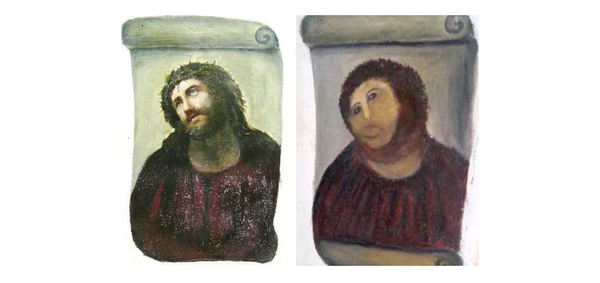
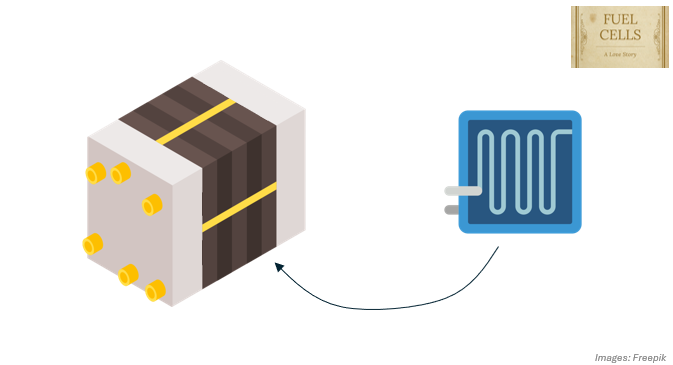
Last time I mapped an “evolutionary tree” of Ballard fuel cell designs and explained how I accidentally made the restored Ecce Homo fresco (colloquially known as the “Monkey Jesus portrait”) of fuel cell catalyst layers when my supervisor Casey entrusted me with that task. Today we’ll recap some early Ballard history, then journey forward.
It had snowed heavily in Vancouver during the holiday break of 1996-1997, and Casey had been snowed in with in-laws; they watched the Star Wars trilogy together. There was only the one trilogy at the time: this was 9 Star Wars movies ago.
The three movies were re-released in theatres in spring 1997, with few minutes of computer-generated imagery added to each. The first movie, Star Wars: A New Hope, had been based on an old samurai one (The Hidden Fortress), and I wondered if the trilogy could get squished back into feudal Japan. Maybe when firearms arrived – those were a Dark Side kind of weapon.
We’ll return to that side quest in 2001, by which point the prequel trilogy was covering the emergence of the Galactic Empire.
Speaking of empires, in 1997 Daimler-Benz bought a 25 percent stake in Ballard.[1]
Daimler-Benz Buys In
Daimler-Benz (now Mercedes-Benz Group AG) had never been a giant automaker, but it had cachet: Karl Benz had invented the first gasoline-powered vehicle (albeit with three wheels) while Gottlieb Daimler co-invented the first gasoline-powered four-wheeler.
From what I was told, Ballard’s leadership had established separately staffed research programs with both Daimler-Benz (the Mk 7 fuel cell design) and General Motors (Mk 8) to improve the odds of getting an equity investment: if they’d only partnered with one automaker, the automaker would have had all the leverage.
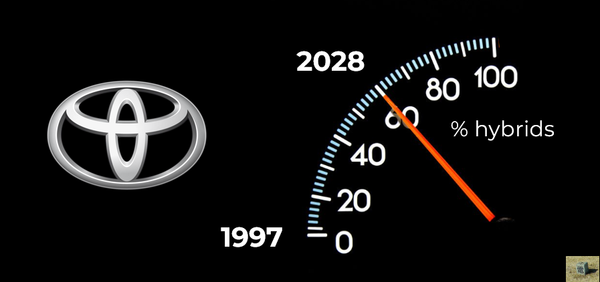
Readers may wonder where batteries figured on Daimler-Benz’s radar. They didn’t: as expensive as lithium-ion batteries were in 2010, they so much more so in 1997. The Toyota Prius, which debuted in December 1997, used nickel metal hydride batteries and sold below manufacturing cost. The roughly contemporaneous GM EV1 battery electric car initially shipped with lead acid batteries.
Battery prices were so high that a few years later, when a visiting Daimler dignitary was asked about hybridizing hydrogen fuel cell vehicles to be similar to the Toyota Prius – this would have made things easier on the fuel cell, simultaneously the most expensive and the least technologically mature part of the vehicle – the response was that batteries were too expensive to add; we would do it all with the fuel cell alone.
Building on my beloved dinosaur analogies, I’d equate the rise of batteries to the rise of mammals. Some dinosaurs – in the form of birds – are still around, but avians are the supporting cast in our current Age of Mammals. Birds’ ancestors were the tiniest sliver of dinosaur types, just as electrochemical fuel processing technologies – such as fuel cells – have only ever been rounding error compared to combustion.
Daimler-Benz’ investment in Ballard was announced in April 1997. Word had filtered down even to the co-op students, and we collectively wished we’d had both investment accounts and money to put into those investment accounts, so we could gamble invest in the stock market. Since the start of the co-op term, the stock had risen about 40 percent; an early lesson that correlation does not imply causation.
One of my classmates – call him Basil – had invested in Ballard early on and was sitting on a pile of profits [by university student standards]. His family’s house burned down around this time. They had insurance, luckily, but the fire put those paper profits in perspective. One of his remaining possessions was the book Sophie’s World, which he’d been reading through between classes – a page-turning mystery novel built around the history of western philosophy. I hope my mis/adventures in fuel cells can illumine the facets of technology development as engrossingly.
What with life events, Basil sold his Ballard shares so he could put his money into something safe; something low risk. On the logic that everyone eventually dies, he put his money into a Canadian funeral home operator.
In June 1999 the Loewen Group declared bankruptcy.
Basil had bet on death – on the inevitability of death – and lost. 🤦 There’s a lesson in there for all the would-be investors out there, but I’m not the one to teach it: this is a technology development series.
... and if you'd like to receive future instalments of this series, sign up below! 😊
King Two (and FedEx)
Ballard’s CEO at the time was Firoz Rasul. He had replaced Geoffrey Ballard around 1989. Prior to Ballard, Firoz had led a small British Columbia startup named MDI (Mobile Data International) which had made it feasible for FedEx to track customers’ packages.
MDI had beaten Motorola for the contract to build portable wireless terminals – bulky computer tablets with physical buttons – for FedEx couriers to use as they made their rounds. They received the good news from FedEx on the same day their not-yet-informed venture capital backers gave them the bad news that there would be no more funding and MDI would have to wind down.[2] MDI survived and Motorola acquired them soon after, to the pleasure and profit of employees and investors alike.
It will not surprise you that Ballard used FedEx as its shipping carriers.
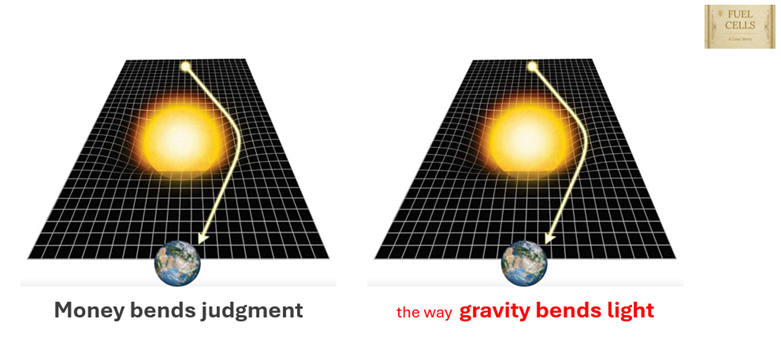
I think money bends judgment the way that gravity bends light, so it’s not in my nature to praise the 0.1 percent. I will make an exception for Firoz. He had enough money to do anything – or nothing – after leaving Ballard. He moved to Pakistan to lead the not-for-profit Aga Khan University, which trains men and women students in the health sciences.
At the time Pakistan ranked 9th in the Fragile States Index (formerly the Failed States Index), educational institutions there were being attacked about a hundred times a year – the education of girls was violently opposed in some regions – and Firoz would spend his waking hours escorted by heavily armed guards. He did this for fifteen years, and he did it pro bono.
There’s a saying that you can’t serve both God and wealth.[3] While Firoz made a lot of money, I wouldn’t group him on Team Wealth. So, in my book – this book – he gets a pass.[4]
King One (and Maple DARPA)
The late Geoffrey Ballard founded his eponymous company in 1979. Like many in that era of oil supply concerns, he had a nuclear-centric vision of the future of energy. British Columbia was a hub for lithium-ion battery development: Moli Energy, now E-One Moli Energy, was the first company – or at least one of the very, very first – to commercialize rechargeable lithium-ion batteries, albeit at a very small scale.
It’s widely known that DARPA – the United States’ Defense Advanced Research Projects Agency – catalyzed the development of several transformative technologies, including stealth technology for military jets, mRNA vaccines, and the internet.
Ballard’s shift to hydrogen fuel cells was the result of a 1983 contract from Canada’s Department of National Defense to explore the technology: fuel cell patents from NASA’s moon missions had by then expired. So, it was a Maple (i.e. Canadian) DARPA-type contract that led to the renaissance of hydrogen fuel cells. Part of the test lab in 1997 was devoted to fuel cells recharging large banks of lead acid batteries; the premise was to use hydrogen instead of diesel for submarines.[5]
From second-hand information, Geoffrey Ballard was big on central fueling-based business models. Public transit buses were an early focus, and two early bus trials were held in Vancouver, Canada and Chicago, United States of America, in 1998; three buses apiece, I think.
After he left the Ballard-the-company, Ballard-the-founder started a second firm, General Hydrogen. General Hydrogen and competitor Cellex saw a promising business case in the central fueling-based niche of warehouse forklifts. Both were acquired by Plug Power in 2007. This means Geoffrey Ballard had his finger on the pulse of the two markets – buses and forklifts – where hydrogen fuel cells enjoyed their earliest successes.
General Hydrogen and Cellex had been in the same business park, and Cellex’s building was later occupied by the nascent Corvus Energy, which at time of writing is the world’s dominant provider of battery systems for maritime vessels. This doesn’t reflect small-world effects, where similar people/organizations cluster together, so much as it reflects the Vancouver area’s desperate lack of industrially zoned land. As such, technology companies trade business addresses the way that hermit crabs trade shells.
Finally, when Hyundai held a Vancouver event for its Tucson hydrogen fuel cell vehicle in December 2014, it held its event at a gallery in front of the city’s Waterfall building. The gallery was originally named the Ballard Lederer Gallery after its two curators, and Jan Ballard was Geoffrey Ballard’s daughter-in-law.
King Three (and David Suzuki)
Firoz’s right-hand man at Ballard Power Systems was the late Mossadiq Umedaly, who as a youth scaled Mt. Kilimanjaro and as a greybeard Chaired the Board of British Columbia’s public electric utility, BC Hydro. And whereas Firoz worked for the Aga Khan University after his Ballard tenure, Mossadiq built the university’s hospital before his.
As Ballard’s CFO, Mossadiq reminded researchers that Ballard’s goal was not to win accolades but to make profits. He mapped his career in ten-year stages, and after nine years left Ballard in 1998. I was told Ballard had difficulty sourcing inverters for its fuel cell systems back then, because the sector was highly fragmented with tiny vendors serving separate, narrow market niches.
So Mossadiq rolled it up.
He joined Xantrex -- a small Vancouver-area inverter manufacturer -- in 1999 as CEO and engineered several acquisitions. The new Xantrex leveraged its scale and product line breadth to become a qualified supplier to major manufacturers and embed itself into their supply chains. In 2008 – a bit less than ten years – Schneider Electric acquired it for about CAD $500 million.
I met Mossadiq once – this was probably the BC Cleantech CEO Alliance Xmas party on 2018 Dec 20 – where he regaled us with career stories. He also shared the advice he once quipped to David Suzuki while serving on the David Suzuki Foundation’s Business Council on Sustainability: “you can be angry or you can be effective; not both”.
Those words stick with me. I wasted a lot of my youth being angry. Like an anti-Dalai Lama.
Anger has a place, but it’s only as striking as its use is sparing. Too many people lean too much on anger too often, and it smothers their message. Like when children drown their fries in ketchup.
Xantrex is one of several Vancouver-area successes that emerged from the Vancouver clean technology industrial cluster Ballard once dominated. We’ll encounter others in due course, but first we’ll move on from 1997: no one stays a co-op student forever. Titanic’s failure modes await.
[1] https://www.nytimes.com/1997/04/15/business/daimler-to-acquire-25-of-ballard-power.html
[2] Humorously enough, MDI did not receive this news from FedEx through e-mail or the older technology of fax (facsimile) machines, but through a still older technology called “telex”.
[3] See the passages Matthew 6:24 and Luke 16:13 from the Christian Bible. I’ve used the translation from the NRSVUE, or New Revised Standard Version Updated Edition, which is the dominant translation used for academic / theological study. One of my goals in eventual retirement will be to complete an undergraduate degree in religious studies.
[4] With the universal caveat of, “unless terrible revelations come out”.
[5] Diesel-electric submarines run on batteries when submerged; when they are one the surface diesel is used for propulsion and to recharge the batteries.