1b: The "Monkey Jesus" of Catalyst Layers
Unfortunately, instead of the glass-smooth surface I’d hoped for, my handiwork was more of a lunar landscape...

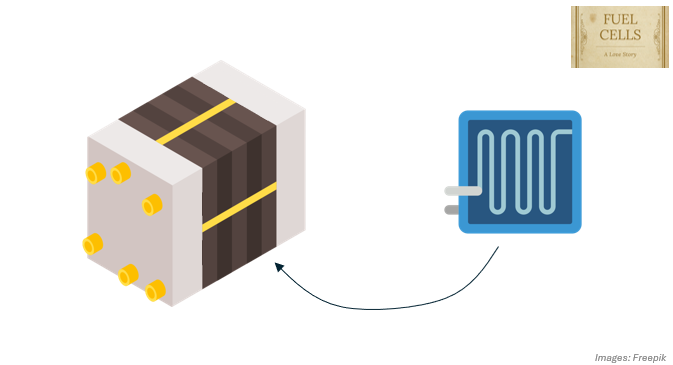
Last instalment I described working on direct methanol fuel cells during my 1997 co-op work terms at Ballard Power Systems. We used a fuel cell design called the Mk4, whose fuel cells were roughly the size of a slice of sandwich bread, but much heavier.
On the hydrogen fuel cell side, the Mk4 cell design had led to the development of Ballard’s much bigger Mk5 cell, used in some very early vehicle demonstrations. As knowledge accumulated, different fuel cell designs were iterated: Mk7, Mk8, Mk9 – and the Mk6000, probably so-named because that design was meant for 250 kW stationary power plants, and its fuel cells were quite large; on par with a pizza box, but much thinner.
Returning to last chapter’s dinosaur references, the horned dinosaurs – ceratopsians, of which Triceratops is the most famous – were very successful. An early evolutionary model had this class of dinosaur evolving from Psittacosaurus, a herbivore with small head and a beak. This led to the burlier Protoceratops, with a beak and a modest frill protecting the neck. Many bigger species followed with beaks, large frills and horns long enough to make rhinos jealous.
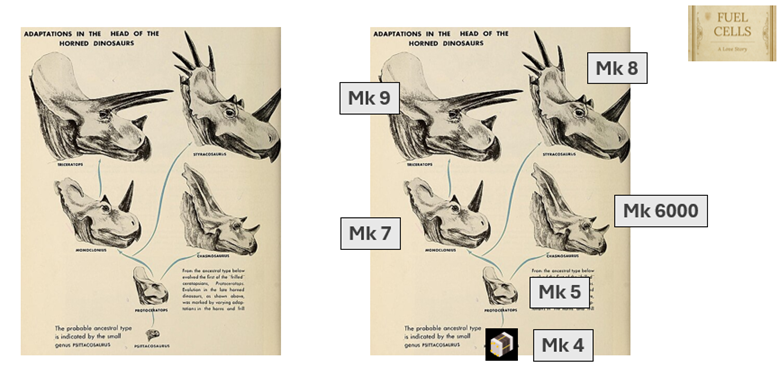
By analogy the Mk4 would have been the Psittacosaurus of Ballard’s proton exchange membrane (PEM) fuel cell designs. There were prior designs – three prior configurations were dubbed Mk1 through Mk3, though they might have been named retroactively – but the Mk4 is the most easily recognizable ancestor of future designs. The much bigger Mk5 followed, and a proliferation of designs after it.
Starting Small
By starting with small designs, Ballard’s fuel cell work followed a common pattern in new technology development:
1. Make it work (at small scale) Mk 4
2. Make it work (at full scale) Mk 5
3. Make it cheaper successive designs
Making things cheaper involves finding alternatives, which themselves will first be evaluated in indicative tests and at small scale, so there’s a Circle of Life element there: technology development as ouroboros.
Starting small helps contain costs, and when you’re producing small numbers of small items in a different ways to create different structures, it isn’t always worth the capital cost – and calendar time – of developing automated equipment. For certain manual processes, the challenge becomes repeatability (variability when the same operator performs a task several times) and reproducibility (variability when several operators perform a task).
In 1997 the platinum containing catalyst layers for direct methanol fuel cells were applied to electrodes using a micro lab spatula.[1] It was the chemistry lab equivalent of using a butter knife to spread a thin, even layer of the world’s most expensive peanut butter on a slice of toast.
This series has also "started small". To help it get bigger, please subscribe below! It'll arrive in your inbox too. 😊
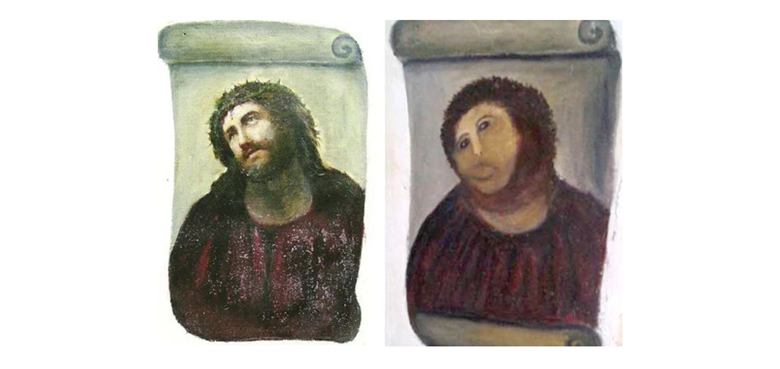
The “Monkey Jesus” of Catalyst Layers
The Ballard team already knew that fuel cells consistently performed better when certain employees applied the catalyst layer, but the reasons were hard to quantify: this was a reproducibility issue. The gold standard for platinum catalyst application was a scientist I’ll call Augusta: the research department’s highest performing fuel cells were the ones she’d applied the catalyst layer to. When new researchers practiced applying catalyst everyone was eager to see if the new employee could match the performance of the “Augusta cell”.
So, when Casey, pleased with my progress, asked if I could step up to apply the catalyst for an upcoming direct methanol fuel cell test, I relished the chance to make a name for myself. Yes, I would sweep the catalyst formulation across the electrode with the broad, coarse strokes of a craftsman, but I would do so with the patient diligence of a pointillist painter.
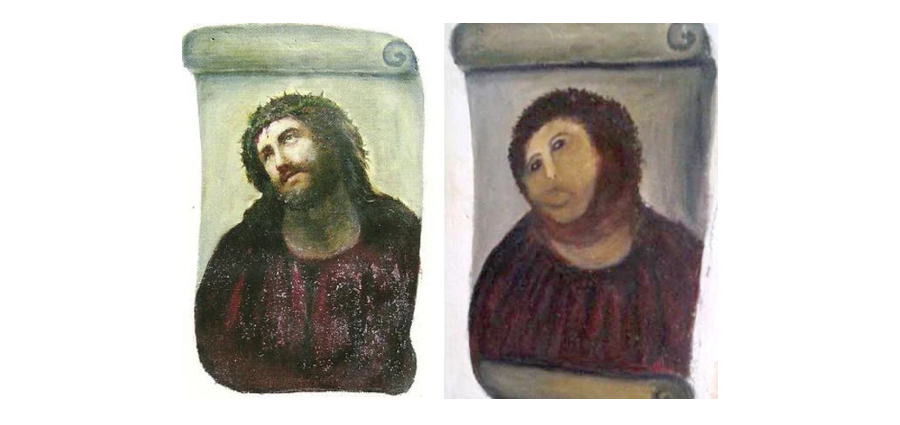
Unfortunately, instead of the glass-smooth surface I’d hoped for, my handiwork was more of a lunar landscape: an “anti-Augusta cell”, if you will. Rather than creating the Ecce Homo fresco of fuel cell catalyst layers, I had created the restored Ecce Homo fresco of fuel cell catalyst layers. Readers probably know it the “Monkey Jesus” portrait made by a clumsy European restorationist.[2]
Showing the restraint of a parent who’d endured his child’s first piano recital, Casey offered encouraging words and suggested we’d steer my skills elsewhere. 😅
Early Misfortune is the Best Fortune
There’s a Zen story where a rich person asks a monk to write a slogan that would bring his family good fortune. The monk writes “father dies, son dies, grandson dies”.
The merchant is outraged, but the monk points out that any other order would represent terrible misfortune. There are as many versions of this story as horned dinosaur species descended from Psittacosaurus.
I think of that story when I think about setbacks. No one wants to fail at things, but failure is part of life, and it’s much better to get your failures in early when the stakes are lower. Success doesn’t hone your focus the way setbacks do.
For example, if you ever become one of the lucky few percent of the people in the world who have money to invest – but are also unlucky enough to have an ego that thinks it can beat the market – you want to get humbled in your 20’s or 30’s. You don’t want to ride a lucky streak, become overconfident, then watch your savings go south in your 50’s or 60’s.
It’s the same with con men. Better to have the cowpox of being tricked early in life by a low-stakes minor grifter, than the smallpox of spending a decade fawning online over a monster like Elon Musk.[3]
I was eventually able to turn the fact that I was bad at “artisanal” practices into a benefit. My lack of skill meant that if I could design a procedure or work protocol detailed enough where even my results 😅 were repeatable (I could get the same result when I performed the task several times) then my colleagues’ results would surely be repeatable too. Furthermore, the variability between colleagues would probably be small too (reproducible).
And in the big picture, the repeatability and reproducibility of tests and procedures are exceptionally important in technology development. They help distinguish the signal from the noise.
I’ll provide more context around 1997 in fuel cells in the next instalment, then we’ll start moving the calendar forward.
[1] Example of a micro lab spatula: https://www.amazon.ca/Scientific-Labwares-Stainless-Spatula-Square/dp/B07V575QGP
[2] https://en.wikipedia.org/wiki/Ecce_Homo_(Garc%C3%ADa_Mart%C3%ADnez_and_Gim%C3%A9nez)
[3] A pre-Elon Musk example is how the New York Times infamously and inexplicably wrote a fluffy, glowing profile of Adolf Hitler on August 20, 1939 – “Herr Hitler At Home In The Clouds”. This was less than two weeks before Nazi Germany invaded Poland, kicking off the Second World War. By this point concentration camps had been running for years and Hitler had annexed Austria, the Sudetenland and Czechoslovakia. https://www.nytimes.com/1939/08/20/archives/herr-hitler-at-home-in-the-clouds-high-up-on-his-favorite-mountain.html