1a: The Iconic Mk4
The Mark 4 (“Mk4”) was an early Ballard fuel cell design, and the one the Direct Methanol Fuel Cell group used at the time.

Last time in Fuel Cells: A Love Story I outlined my three goals for this essay collection. We left off at 9:01 a.m. on the first day of my co-op [internship] term at Ballard Power Systems in 1997.
After connecting with our supervisors and unloading our jackets and backpacks at our desks, we made our way to a group safety orientation, which the safety coordinator launched into by saying that safety wasn’t his job. It was everyone’s job.
I won’t subject you to every detail – I’m not trying to beat Proust’s seven-volume In Search of Lost Time here – but like Proust, part of my narrative comes from involuntary memory: those flashes that sometimes come to mind during the most quotidian of everyday routines.
Structure-wise I’ll quickly recap years pre-1999; go through some basics of the proton exchange membrane (PEM) fuel cell; then the bulk of the narrative will cover 1999 onwards. That neatly splits things into the “pre-Matthew era”, an overview of PEM fuel cell stack components, and then “technology development Matthew experienced”.[1]
While steering clear of anything confidential, of course. I’m not looking to pull a Suetonius here.[2]
Direct Methanol Fuel Cells
From nature or nurture, we Klippensteins are eccentric – as a kid I preferred the uniquely club-tailed Ankylosaurus over Triceratops and T. Rex, my doctor told me for the past two years to add more salt to my diet,[3] and two of my relatives use the Dvorak keyboard layout – so it fits my life’s leitmotif that while the rest of Ballard Power Systems was working on hydrogen fuel cells, my co-op supervisor led the Direct Methanol Fuel Cell, or DMFC, research. For these fuel cells, instead of gaseous hydrogen being used as the fuel for electrochemical reactions, [liquid] methanol or a methanol/water mixture are used instead.
A, ahem, “few” years later, the first profitable, publicly listed fuel cell company [SFC] would be one focused on direct methanol fuel cells.[4] Theirs is a razor / razor blade model: make the profits by selling proprietary fuel cartridges.
Methanol was of interest to the automakers Ballard had been working with, because it is a liquid at room temperatures, had acceptable energy density even if diluted with water, and was already used in car racing. It was possible – if not practical – to store methanol on a car, chemically “reform” it to produce hydrogen and run the hydrogen through the fuel cell. But suppose you could generate enough power by pumping methanol through the fuel cell directly?
Methanol’s colourless flames remained a concern – pure hydrogen’s flames aren’t particularly visible either – but from the time early humans learned how to use fire without burning themselves, we’ve overcome safety challenges. If you’d told Canada’s first Prime Minister John A. MacDonald that people would soon travel safely in carriages powered by controlled explosions, he’d think you’d had too much to drink.
[International readers: MacDonald was a high-functioning binge drinker who found time to serve as Canada’s Prime Minister from 1867-1873 and 1878-1891.]
My supervisor – let’s call him Casey – didn’t have any full-time employees reporting to him, so I took impish pride in being the company’s second-most senior person in the DMFC team. An irrepressible keener, I tried to get to work before him, leave after him, and – on select occasions – to out-dress him. I once showed up in a white turtleneck and slacks, and he asked if I was going to dinner at the yacht club that evening.
While I would start testing after I arrived in the morning – there would be plenty of employees circulating – I didn’t test after hours. There was a proper company policy to keep safety, and especially co-op student safety, first. So, I would end my days at the computer, and sometimes on the internet.
In early 1997 the Spice Girls dominated pop radio, but it was 1997 so Google and its search engine didn’t yet exist. Typing “Spice Girls” into an internet search engine led you to very different … women entertainers, and I resolved to only look up music groups from home going forward.
The anecdote captures the nature of technological progress. Internet search started off terrible but got much better over time. As I write this, AI seems to be partway through that “terrible-to-terrific” transition. I will have the privilege of sharing some of those early, decades-ago advances in the evolution of PEM fuel cells. Hopefully readers will have seen big progress in fields of life important to them too.
The Mk4
The Mark 4 (“Mk4”) was an early Ballard fuel cell design, and the one the Direct Methanol Fuel Cell group used at the time. The individual cells were square – very roughly the size of a slice of square sandwich bread, but much, much heavier. Within the fuel cell / slice of sandwich bread, electrochemical reactions would only take place in a square area in the middle. For the Mk4 the size of the “active area” was about 50 cm2 – about the size of square Post-It™ notes. Inlet and outlet ports for the fuel, oxidant (air) and coolant were arrayed around the active area, contributing to the cell’s slice-of-sandwich-bread size.
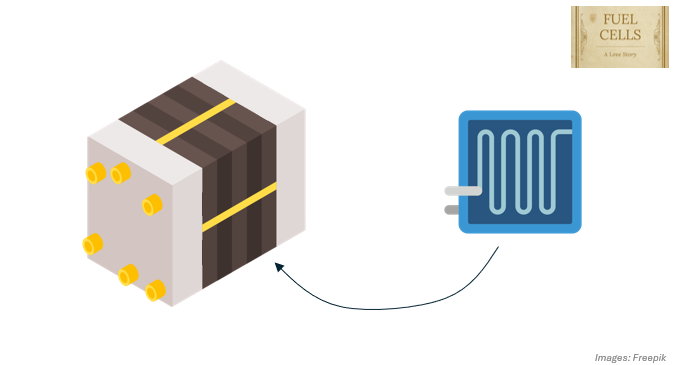
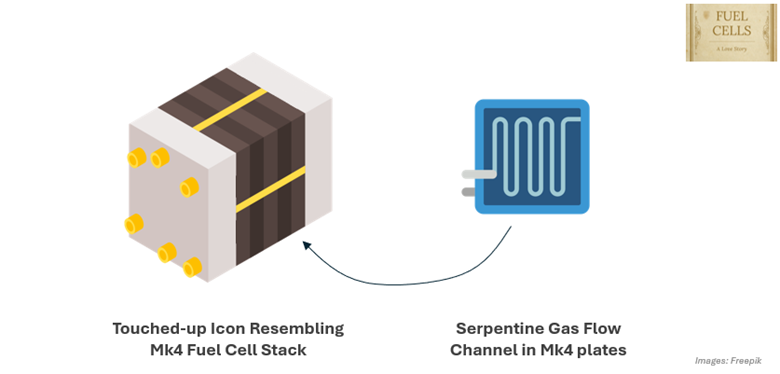
I won’t get into the specifics of proton exchange membrane fuel cells yet – readers haven’t had enough time to relate to our cast of characters – but the left side image above is a touched-up version of the fuel cell icon from Freepik. The original image combines elements of a single fuel cell and a fuel cell stack. Hardly Freepik’s fault, we’re all beginners at 99 percent of life and experts at one.
On the left side are inlets and outlets for fuel, air, and coolant. The grey slabs on either end represent the end hardware, which doesn’t itself participate in the power generation. The yellow lines are tie rods, used to keep the fuel cell under compression. Each of the five dark slabs would represent a sandwich-bread-slice sized fuel cell. This highly simplified icon would then represent a stack of 5 fuel cells, or a 5-cell fuel cell stack.
The right-side icon, also from Freepik, is a simplified representation of the active area portion of a flow field plate, whose role is to provide gases for the reactions and to conduct electrons away. The plate has a channel cut into it, through which the reactants would flow, and the channel has a serpentine pattern, travelling back and forth across the active area from the inlet to the outlet.
The hydrogen (or in Casey’s and my case, methanol) would travel through the channel on the fuel plate on one side of the proton exchange membrane. On the other side, air would travel through the channel on the oxidant plate. The coolant would typically flow through a channel on the opposite side of the fuel plate.
We’ll revisit this in more and clearer detail soon. Next, in "PEM Psittacosaurus", I want to explain where the Mk4 fit on the evolutionary tree of Ballard’s early fuel cell designs.
[1] If you have English literature or Classical Studies majors in your life, the fuel cell stack components section will be like the Catalogue of Ships in The Iliad. It happens early on, gives a who’s who of the participants – in our case, a what’s what of fuel cell components – and then the rest of the technology development story unfolds.
[2] Suetonius, “Father of Gossip Magazines”, is discussed in the prior chapter.
[3] This is true. It seems I drink so much water during the day that I chronically deplete my electrolytes.
[4] A *little* bit more than a few. Check out one of the interviewees! https://www.canarymedia.com/articles/hydrogen/a-profitable-fuel-cell-company-finally-emerges-amid-industrywide-losses